
How to Charge an AGM Battery: Correct Voltage, Settings & Step-by-Step Guide
Learn how to charge AGM batteries correctly. Float voltage 13.5-13.8V, charge voltage 14.4-14.7V, temperature compensation -3mV/°C/cell. Factory charging guide from a VRLA manufacturer.
Quick Answer: AGM Battery Charging Voltage
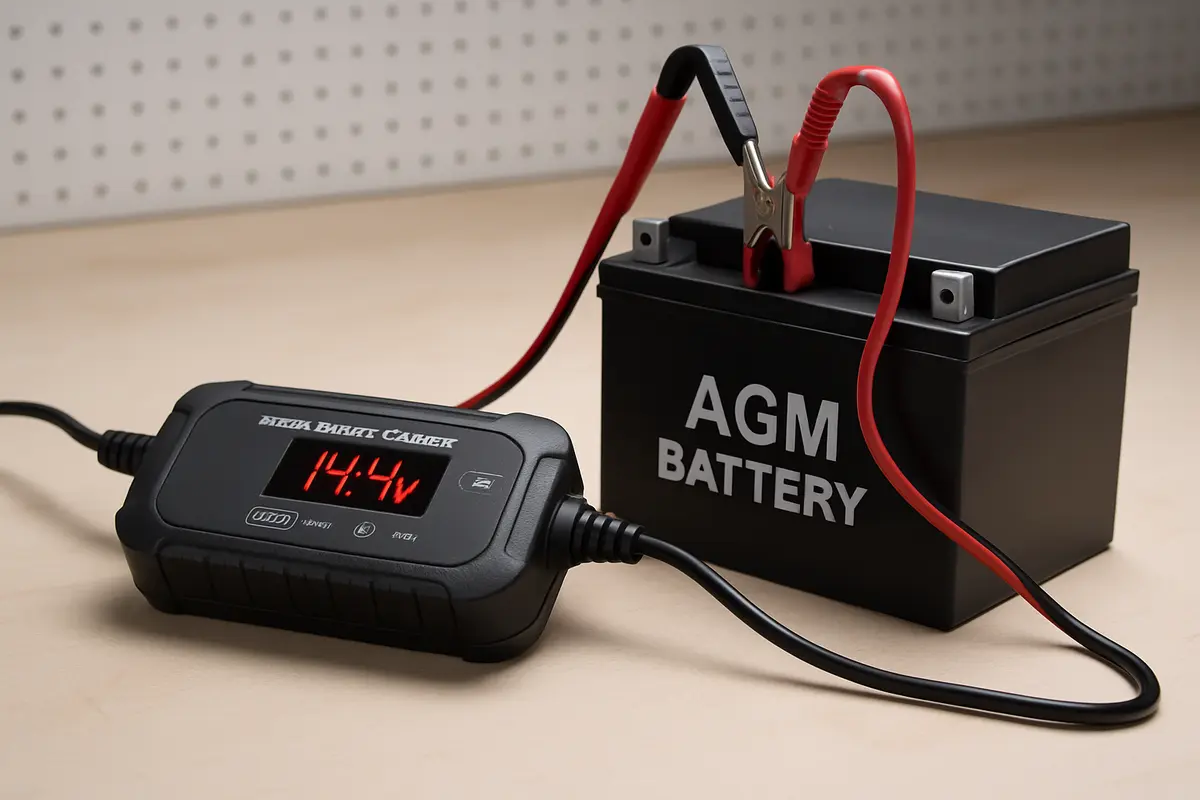
Float charge (standby): 13.50-13.80V for a 12V AGM battery (2.25-2.30 V/cell) Bulk/absorption charge: 14.40-14.70V for a 12V AGM battery (2.40-2.45 V/cell) Maximum voltage — never exceed: 14.70V (2.45 V/cell) — going higher causes irreversible damage Temperature compensation: Reduce voltage by 3 mV per cell for every 1°C above 25°C
These values apply to standard VRLA AGM batteries including the Naradex ND12 series. Always verify with your specific battery manufacturer's datasheet.
Why Correct Charging Matters for AGM Batteries
AGM batteries are sealed — they cannot be refilled with water if overcharged. Unlike flooded batteries where water loss from overcharging can be replenished, AGM batteries will permanently lose capacity and lifespan if charged at incorrect voltages.
What happens with wrong charging voltages: - **Too high (>14.7V at 25°C):** Excessive gassing, electrolyte dry-out, thermal runaway risk, valve venting, permanent capacity loss. Battery life can drop from 5-8 years to 1-2 years. - **Too low (<13.2V float):** Chronic undercharging, sulfation buildup on plates, gradual capacity loss, inability to deliver rated power during discharge. - **No temperature compensation:** At 35°C, a battery floated at 13.8V is effectively being overcharged (equivalent to ~14.1V at 25°C). At 10°C, the same 13.8V is effectively undercharging.
Step-by-Step: Charging a New AGM Battery
Step 1: Verify Battery Voltage Before Charging
Measure the open-circuit voltage (OCV) with a multimeter after the battery has rested for at least 2 hours:
Step 2: Select the Correct Charger Mode
Use a charger with an **AGM, VRLA, or Sealed** mode. If your charger only has "Flooded" and "Gel" modes, use the **Gel mode** — it has a lower voltage ceiling that is safer for AGM (though not optimal).
Charger requirements: - Voltage regulation: ±1% accuracy (±0.14V for a 12V battery) - Current limiting: Maximum 0.25C (25A for a 100Ah battery) - Temperature compensation: -18 mV/°C for a 6-cell (12V) battery - Multi-stage charging: At minimum, CC-CV (constant current → constant voltage)
Step 3: Bulk Charge Phase (Constant Current)
Connect the charger and set it to bulk charge at 14.40-14.70V with current limited to 0.20C-0.25C:
- For a **100Ah battery**: Maximum charge current = 25A - For a **200Ah battery**: Maximum charge current = 50A - For a **26Ah battery**: Maximum charge current = 6.5A
The battery will accept maximum current until it reaches the set voltage. This phase typically restores 70-80% of the battery's capacity.
Step 4: Absorption Charge Phase (Constant Voltage)
Once the battery reaches 14.40-14.70V, the charger switches to constant voltage mode. The current gradually decreases as the battery approaches full charge. Maintain the absorption voltage until the charge current drops below 0.02C (2A for a 100Ah battery).
Duration: 2-6 hours depending on the depth of discharge and battery capacity.
Step 5: Float Charge Phase (Maintenance)
After the absorption phase completes, reduce the voltage to **13.50-13.80V** for float (maintenance) charging. This voltage sustains the battery at 100% charge without overcharging. In UPS and telecom applications, the battery remains at float voltage for its entire standby life (years).
Temperature Compensation Table
Temperature compensation is critical for AGM battery longevity. Apply these adjustments to the standard 25°C values:
Formula: Adjusted voltage = Reference voltage - [0.003 × (T - 25) × Number of cells]
For a 12V battery (6 cells): Adjustment = 0.018V per °C difference from 25°C.
Common Charging Mistakes to Avoid
1. Using a flooded battery charger without AGM mode. Many older chargers apply equalization voltages (15.0-16.0V) that will destroy AGM batteries within months.
2. Connecting to a solar charge controller set for flooded batteries. Solar MPPT controllers must be programmed for AGM voltage profiles. Most quality controllers (Victron, Epever, Morningstar) have a dedicated AGM setting.
3. Charging in a hot environment without temperature compensation. A battery room at 35°C that receives 13.8V float is being overcharged by approximately 0.18V — enough to reduce battery life by 30-50%.
4. Fast charging above 0.30C. High charge currents generate internal heat that AGM batteries dissipate poorly (because the electrolyte is immobilized). Limit charge current to 0.25C for standard AGM batteries and 0.15C for deep-discharged batteries.
5. Leaving an AGM battery deeply discharged. If an AGM battery sits below 10.5V for extended periods, irreversible sulfation occurs. The lead sulfate crystals harden and become non-reactive. A deeply discharged AGM battery should be charged within 48 hours.
UPS and Telecom Charging Systems
Most modern UPS and telecom rectifier systems charge AGM batteries correctly out of the box. However, verify these settings:
UPS systems (APC, Eaton, Schneider, Huawei): - Float voltage should read 2.25-2.30 V/cell on the UPS display - Check that temperature compensation is enabled if the UPS supports it - Some UPS models have a "boost charge" feature — verify it does not exceed 2.45 V/cell
Telecom rectifiers (Huawei, Eltek, Emerson/Vertiv): - Float voltage: 53.5-54.0V for 48V systems (24 cells × 2.23-2.25 V/cell) - Boost voltage: 55.2-56.4V for 48V systems (24 cells × 2.30-2.35 V/cell) - Low voltage disconnect (LVD): 43.2V (24 cells × 1.80 V/cell) - Temperature compensation: Enabled and calibrated with battery room sensor
Related Resources
- [AGM vs Lead Acid Battery](/blog/agm-vs-lead-acid-battery-difference/) — Understand the differences - [AGM vs Gel Battery for UPS](/blog/agm-vs-gel-battery-which-is-better-for-ups/) — Compare VRLA types - [VRLA Battery Maintenance Guide](/blog/vrla-battery-maintenance-guide/) — Best practices for long life - [Our AGM Battery Products](/products/12v-agm-battery/) — View the Naradex ND12 series