
AGM vs Lead Acid Battery: Key Differences, Pros, Cons & When to Use Each
AGM vs lead acid battery — what is the difference? Compare construction, performance, lifespan (5-12 vs 3-5 years), cost, and best applications. Factory test data from a battery manufacturer.
Quick Answer: AGM vs Lead Acid
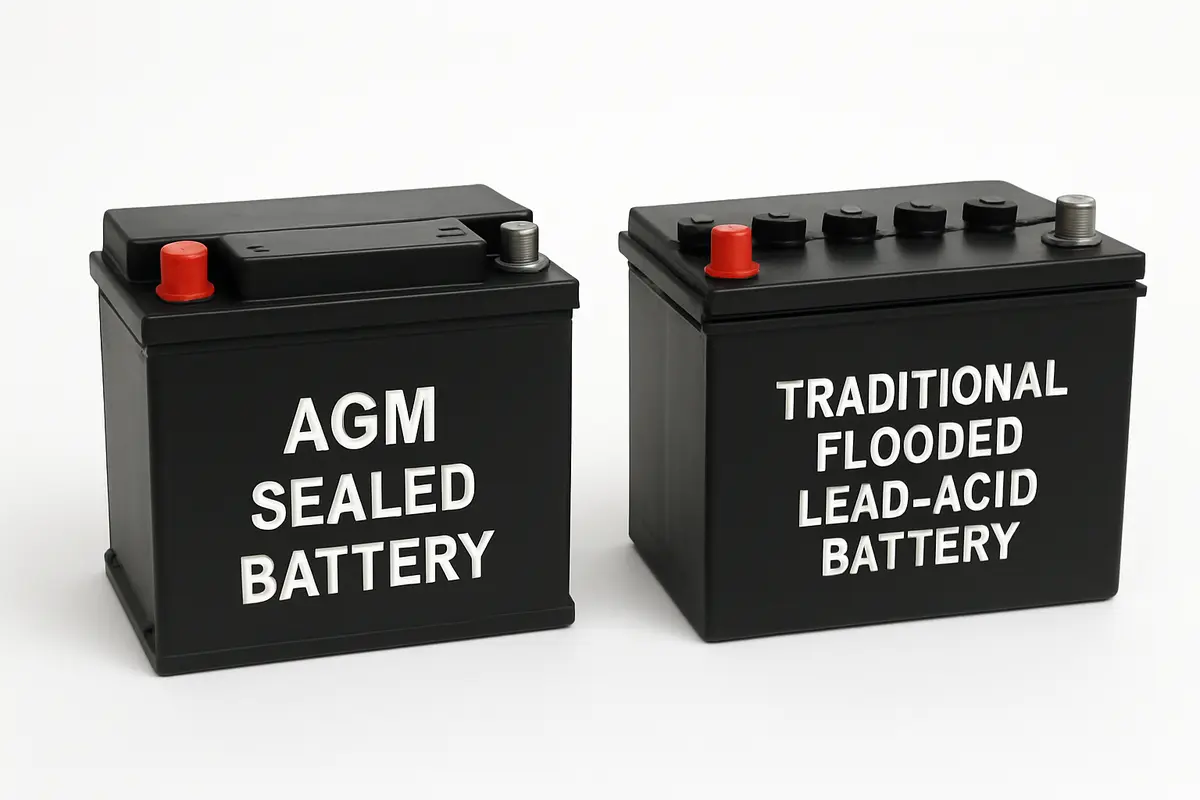
AGM (Absorbed Glass Mat) batteries are a type of lead-acid battery — but they differ fundamentally from traditional flooded (wet-cell) lead-acid batteries. AGM batteries use a fiberglass mat to absorb and immobilize the electrolyte, making them sealed, spill-proof, and maintenance-free. Flooded lead-acid batteries use liquid sulfuric acid that requires regular water top-ups and upright installation.
For **UPS backup and telecom applications**, AGM batteries are the standard choice due to their sealed construction, low self-discharge (1-3% per month vs 5-15%), and superior high-rate discharge performance.
How AGM Batteries Work
AGM batteries use a **thin fiberglass mat** (typically 1.0-1.3 mm thick) sandwiched between the positive and negative lead plates. This mat absorbs approximately 95% of the sulfuric acid electrolyte through capillary action, leaving the remaining 5% as a gas space that enables the oxygen recombination cycle — the process that makes sealed VRLA batteries possible.
When the battery charges, oxygen gas generated at the positive plate travels through the unfilled pores in the glass mat to the negative plate, where it recombines with hydrogen to form water. This **oxygen recombination** eliminates the need for water addition and allows the battery to be sealed with a pressure-relief valve (hence "Valve Regulated Lead Acid" or VRLA).
Key construction details: - Plate alloy: Calcium-lead (Pb-Ca) for low water loss and long float life - Separator: Absorptive Glass Mat, boron-silicate microfiber - Electrolyte: Sulfuric acid (H₂SO₄), specific gravity 1.28-1.30 at 25°C - Case: ABS or PP (polypropylene), flame retardant to UL 94 V-0
How Flooded Lead-Acid Batteries Work
Flooded (or "wet-cell") batteries use the same lead-plate electrochemistry but with a **liquid electrolyte** that freely covers the plates. The sulfuric acid solution can move, slosh, and stratify within the cell. During charging, hydrogen and oxygen gases are generated and **vented directly to the atmosphere** — which is why these batteries require periodic water addition to replace the electrolyte lost through gassing.
Key characteristics of flooded batteries: - Electrolyte: Free-flowing liquid sulfuric acid - Venting: Open vent caps or flame-arrestor caps - Maintenance: Regular water addition required (every 1-3 months) - Installation: Must be installed upright to prevent acid spillage - Gassing: Produces hydrogen gas during charging (ventilation required)
AGM vs Lead Acid: Side-by-Side Comparison
When to Choose AGM Batteries
AGM batteries are the right choice when:
1. No maintenance is possible or desirable. In telecom tower sites, unmanned data centers, and building UPS rooms, there is no technician to check water levels. AGM batteries operate for their entire 5-12 year design life without maintenance intervention.
2. The installation space is enclosed or poorly ventilated. AGM batteries emit minimal hydrogen gas under normal float charging conditions — typically less than 0.01% of the ventilation requirement of flooded batteries. This makes them suitable for office environments, server rooms, and enclosed equipment cabinets per IEC 62485-2.
3. High-rate discharge performance matters. UPS applications require the battery to deliver high current for short durations (5-30 minutes). AGM batteries have lower internal resistance than flooded batteries, providing more watts per kilogram during high-rate discharge. Our Naradex ND12-100 delivers 360W per cell at the 15-minute rate — 15-20% higher than equivalent flooded batteries.
4. You need reliable standby power in varying temperatures. AGM batteries tolerate temperature extremes better than flooded batteries because the immobilized electrolyte cannot freeze or stratify. At -20°C, an AGM battery retains approximately 50% of its rated capacity, while a flooded battery may drop to 30-40%.
When to Choose Flooded Lead-Acid Batteries
Flooded batteries still make sense in specific applications:
1. Deep cycling applications where cost is the priority. For solar off-grid systems, floor scrubbers, and electric forklifts where the batteries are cycled daily, flooded deep-cycle batteries offer the lowest cost per cycle — especially industrial tubular plate designs (OPzS) that achieve 1,500+ cycles at 80% DOD.
2. Large stationary installations with dedicated battery rooms. Utility substations and large telecom central offices often use flooded cells in ventilated battery rooms where maintenance is regularly performed. The lower upfront cost of flooded batteries becomes significant at the 1,000+ kWh scale.
3. Applications where equalization charging is standard practice. Flooded batteries benefit from periodic equalization charging (controlled overcharge at 15.0-16.0V for 12V batteries) that remixes stratified electrolyte. AGM batteries have limited tolerance for equalization and can be damaged by excessive overcharge.
Charging Differences: AGM vs Flooded
One of the most critical differences between AGM and flooded batteries is the charging profile. Using the wrong charger settings can permanently damage AGM batteries.
Critical rule: Never exceed 14.7V (2.45 V/cell) when charging AGM batteries. Higher voltages cause excessive gassing that the sealed cell cannot vent fast enough, leading to dry-out, thermal runaway risk, and premature failure.
Lifespan Comparison: Real-World Data
Battery lifespan depends heavily on temperature, charge voltage, and depth of discharge. Here is what we observe from factory testing and field installations:
AGM batteries (Naradex ND12 series): - Design floating life: 5-8 years at 25°C (standard series), 10-12 years at 25°C (long-life series) - Cyclic life: 800 cycles at 50% DOD (standard), 1,200 cycles at 50% DOD (enhanced) - Temperature derating: Every 8-10°C above 25°C halves the expected life (Arrhenius equation) - Field average: 6-8 years in well-maintained UPS installations at 20-25°C
Flooded lead-acid batteries: - Design life: 3-5 years (automotive), 5-8 years (industrial deep cycle), 15-20 years (tubular OPzS) - Cyclic life: 300-500 cycles at 50% DOD (flat plate), 1,500+ cycles at 80% DOD (tubular) - Temperature derating: Similar Arrhenius relationship but more tolerant of occasional high temperatures - Field average: 3-4 years (automotive), 8-12 years (well-maintained industrial)
Cost Analysis: Total Cost of Ownership
While AGM batteries cost more upfront ($1.50-$3.50/Ah vs $0.80-$1.50/Ah at OEM volumes), the total cost of ownership often favors AGM in backup applications:
AGM total cost advantage: - No maintenance labor cost (flooded batteries require 2-4 hours/quarter for water checks and cleaning) - No ventilation infrastructure cost (flooded battery rooms require hydrogen extraction systems per IEC 62485-2) - No acid-resistant flooring or spill containment - Lower replacement frequency (5-8 years vs 3-5 years typical) - Lower shipping cost (classified as non-spillable per IATA/DOT, no hazmat surcharges)
For a typical 10 kVA UPS installation (8 × 12V 100Ah batteries): - AGM upfront cost: $1,200-$2,400 - Flooded upfront cost: $640-$1,200 - AGM 10-year total cost (1.5 replacements): $1,800-$3,600 - Flooded 10-year total cost (2.5 replacements + maintenance): $2,400-$4,800
Manufacturing Quality Factors
As a battery manufacturer producing both AGM and flooded batteries since 2006, we can share the key quality indicators to look for when sourcing:
For AGM batteries: - **Plate alloy composition**: High-tin calcium-lead alloy (Pb-Ca-Sn, 0.06-0.08% Ca, 0.5-1.5% Sn) ensures long float life and corrosion resistance - **Glass mat quality**: Uniform fiber distribution and controlled porosity (93-95% electrolyte absorption) - **Assembly pressure**: Proper plate-to-mat compression ratio prevents acid starvation and ensures consistent performance - **Container sealing**: Heat-sealed ABS/PP case with rated safety valve (opening pressure 10-40 kPa)
For flooded batteries: - **Plate thickness**: Thicker plates = longer cycle life (3.0-3.5 mm for deep cycle vs 1.5-2.0 mm for starting) - **Antimony content**: Low-antimony alloy (1.5-3.0% Sb) for deep cycle, calcium alloy for maintenance-free starting - **Separator material**: Polyethylene envelope separators prevent dendrite shorts
Related Resources
- [AGM vs Gel Battery: Which Is Better for UPS?](/blog/agm-vs-gel-battery-which-is-better-for-ups/) — Compare the two main VRLA types - [VRLA Battery Maintenance Guide](/blog/vrla-battery-maintenance-guide/) — Best practices for maximizing battery life - [How to Choose a UPS Battery](/blog/how-to-choose-ups-battery-complete-guide/) — Complete buyer's guide - [Our AGM Battery Products](/products/12v-agm-battery/) — View the Naradex ND12 series