
AGM vs Gel Battery for UPS Systems — Which Is Better for Your Data Center?
Deep technical comparison of AGM and Gel VRLA batteries for data center UPS. Covers Tier classification, redundancy architecture, TCO modeling, and charge profile tuning. Factory direct pricing. Get quote →
Quick Answer: AGM Wins for Most Data Centers, Gel Wins for Edge Sites
If your data center has climate-controlled battery rooms (20-25°C), N+1 or 2N UPS redundancy, and batteries in standby float mode 99%+ of the time, AGM is the right choice — it delivers 20% higher power density and costs 40-60% less upfront than gel. But if you are operating edge data centers in hot climates without dedicated HVAC, or your site experiences frequent utility cycling, gel (OPzV) batteries will outlast AGM by 2-3x and deliver lower total cost of ownership over a 15-year horizon.
This guide goes beyond the basic chemistry differences and focuses on what actually matters in data center environments: high-rate discharge performance, thermal runaway risk, Tier-level reliability requirements, and 10-year TCO modeling.
Understanding Data Center Battery Requirements
Data center UPS batteries face a unique operational profile that differs significantly from telecom, solar, or general industrial applications:
Standby float service: Batteries sit at float voltage 99.5%+ of the time, discharging only during utility outages — typically less than 10 events per year.
High-rate discharge: When a discharge occurs, it is a high-rate event — the UPS must deliver full rated power for 5-30 minutes until generators start and stabilize. This demands low internal resistance and excellent high-current performance.
Mission-critical reliability: A Tier III data center requires 99.982% uptime (1.6 hours downtime per year). A Tier IV requires 99.995% (26 minutes per year). Battery failure during a utility outage causes the most expensive type of data center downtime — unplanned and complete.
Environmental control: Most Tier III/IV facilities maintain battery rooms at 20-25°C with dedicated HVAC. Edge sites and Tier I/II facilities may have less stringent temperature control.
AGM Technology: Strengths for Data Center Use
AGM (Absorbed Glass Mat) batteries use a fiberglass separator saturated with sulfuric acid electrolyte. The key properties that make them dominant in data center applications:
High-Rate Discharge Performance
AGM's internal resistance is typically 15-25% lower than equivalent gel batteries. For a 12V 100Ah battery:
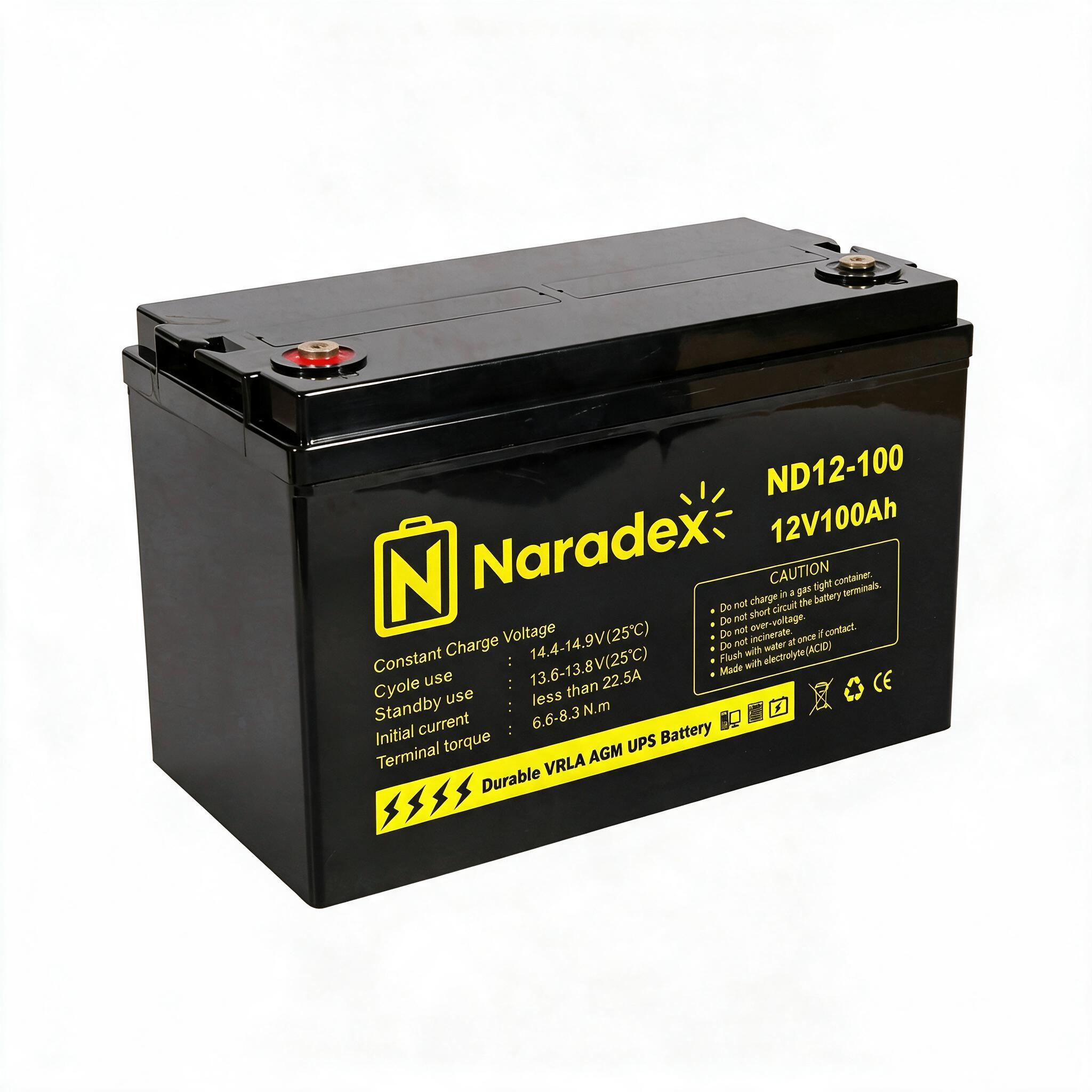
- **Naradex ND12-100 (AGM):** Internal resistance ≤ 4.5 mΩ, delivers 180A for 15 minutes at 25°C - **Typical gel equivalent:** Internal resistance 5.5-7.0 mΩ, delivers 140-150A for 15 minutes
This matters because UPS battery strings are sized for worst-case high-rate discharge. Lower internal resistance means fewer battery strings needed to support the same load — reducing cost, footprint, and weight.
Fast Recharge
AGM accepts charge current up to 0.3C (30% of rated capacity), allowing full recharge in 4-6 hours after a discharge event. Gel batteries are limited to 0.15-0.2C charge rates and require 8-12 hours for full recharge.
In data centers with frequent utility instability, this difference determines whether batteries are fully charged for the next outage.
Float Life in Controlled Environments
At 25°C constant temperature, Naradex ND12 high-rate series achieves 10-12 year float design life. Standard AGM typically achieves 5-8 years. The Arrhenius equation predicts that every 10°C reduction below 25°C extends life by approximately 2x — so data centers at 20°C can expect 15+ year AGM life.
Gel (OPzV) Technology: When It Outperforms AGM
Gel batteries use silica-thickened sulfuric acid that forms a rigid gel matrix. The gel eliminates acid stratification and provides superior performance in specific conditions:
Thermal Resilience
Gel batteries tolerate high-temperature operation far better than AGM. At 35°C continuous operation:
*Source: Naradex factory accelerated life testing per IEC 60896-21/22*
For edge data centers in the Middle East, Southeast Asia, or Africa where ambient temperatures routinely exceed 35°C, gel batteries are the economically rational choice despite their higher initial cost.
Deep Cycle Durability
If your UPS cycles frequently — more than 50 deep discharge events per year — gel's tubular plate construction provides dramatically better cycle life:
- **AGM (ND12 series):** 800 cycles at 50% DOD, 300 cycles at 80% DOD - **OPzV Gel (Naradex OPzV series):** 1,500 cycles at 50% DOD, 1,200 cycles at 80% DOD
This makes gel the clear winner for regions with unstable grid power (parts of Africa, South Asia, Latin America) where the UPS may cycle daily.
Acid Stratification Immunity
In tall 2V cells (400mm+ height), AGM batteries can develop acid stratification — the acid concentration becomes higher at the bottom and lower at the top of the cell, causing uneven plate corrosion and premature failure. Gel's rigid electrolyte completely eliminates this failure mode.
For utility-scale UPS using 2V cell strings (120-240 cells in series), this is a significant reliability advantage.
Head-to-Head: Data Center Performance Matrix
10-Year TCO Model: A Real Example
Consider a 200 kW UPS system requiring 15 minutes of backup at 192V DC bus:
AGM Configuration (ND12-100): - 16 batteries per string × 4 parallel strings = 64 batteries - Initial cost: ~$7,000 per string × 4 = $28,000 - Expected replacement at year 7: $28,000 - 10-year total: ~$56,000
Gel Configuration (OPzV2-500, 2V cells): - 96 cells per string × 2 parallel strings = 192 cells - Initial cost: ~$55,000 - Expected replacement: none within 10 years - 10-year total: ~$55,000
Result: At 10 years, costs are nearly identical. But gel provides zero mid-life disruption — no need to schedule a battery replacement that takes the UPS offline for maintenance.
Charging Requirements: Getting It Wrong Is Expensive
One of the most common causes of premature battery failure in data centers is incorrect charge voltage settings. AGM and gel batteries have different optimal charge profiles, and using the wrong settings will shorten life by 30-50%.
*Source: Naradex ND12 and OPzV series datasheets, per IEC 60896-21/22*
Critical warning: Overcharging gel batteries (exceeding 14.4V for 12V units) creates permanent gas pockets in the gel electrolyte that cannot recombine. This damage is irreversible and will progressively reduce capacity. Most data center UPS systems ship with AGM-optimized charge settings — if you switch to gel, you must reprogram the charger.
Thermal Runaway Risk Assessment
Thermal runaway — a self-accelerating exothermic failure where battery temperature rises uncontrollably — is a serious concern in data center battery rooms. While rare, it can cause fires, release toxic gases (hydrogen, sulfuric acid mist), and destroy adjacent equipment.
AGM risk factors: - Higher internal resistance = more heat during charge - Faster degradation at elevated temperatures creates positive feedback loop - More susceptible when float voltage is set too high - Reported incidents in data centers typically involve aging AGM batteries (>7 years) with drifted float voltage
Gel risk factors: - Lower thermal runaway risk due to gel's thermal stability - Higher activation energy required for thermal runaway - Gel electrolyte acts as thermal buffer
Best practice: Install battery monitoring systems (BMS) that track individual battery/cell impedance, temperature, and voltage. Early detection of impedance rise or temperature deviation prevents thermal runaway regardless of technology. Naradex recommends monitoring per IEEE 1188 and IEEE 1491 standards.
Decision Framework: Which to Choose
Choose AGM when: - Battery room temperature is maintained at 20-25°C - Discharge events are infrequent (< 20 per year) - Runtime requirement is 5-30 minutes (high-rate discharge) - Budget is constrained - Rack space is limited (AGM has smaller footprint) - UPS redundancy is N+1 or 2N (a single battery failure doesn't cause downtime)
Choose Gel (OPzV) when: - Operating temperature exceeds 30°C regularly - Grid instability causes frequent cycling (> 50 discharges/year) - Required service life exceeds 12 years without replacement - Using large 2V cell strings where acid stratification is a concern - Maximum reliability is the priority over initial cost - Thermal runaway risk must be minimized (e.g., battery room adjacent to IT equipment)
Naradex Product Recommendations by Application
Related Resources
- [AGM vs Gel Battery: Which Is Better for UPS Backup Power?](/blog/agm-vs-gel-battery-which-is-better-for-ups/) — General comparison for all UPS applications - [How to Choose UPS Battery: Complete Buying Guide](/blog/how-to-choose-ups-battery-complete-guide/) — Step-by-step selection process - [Battery Backup Time Calculator](/blog/battery-backup-time-calculator-how-long-will-ups-last/) — Calculate runtime for your load - [SLA vs AGM vs Gel Battery Comparison](/blog/sla-vs-agm-vs-gel-battery-comparison/) — Broader technology overview - [VRLA Battery Maintenance Guide](/blog/vrla-battery-maintenance-guide/) — Maximize battery lifespan
Get a Free Data Center Battery Assessment
Naradex manufactures both AGM and OPzV gel batteries with 15+ years of experience supplying data centers, telecom operators, and utility companies across 60+ countries. Our engineering team can provide a free battery sizing and technology recommendation based on your specific site conditions, load profile, and reliability requirements.
[Request a Quote](/contact/)